
24" Stop/Slow paddle
Retroreflective, with a two-piece or three-piece support pole. Many styles to choose from.
PPE guides
These are the personal protective equipment checklists we give our flaggers and our shipyard workers. Buying the right gear once is cheaper than buying it twice.
Flagger PPE
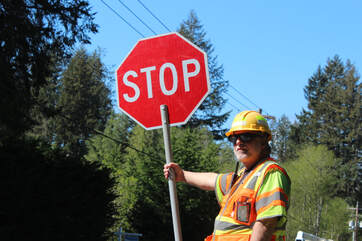
The following are examples of the PPE and equipment a flagger must have to perform their duties during daytime work.
In Washington state hi-visibility hard hats must be white, yellow, yellow-green, orange or red. They must have 12 square inches of reflective material applied for nighttime use.
In Washington state hi-visibility garments must be fluorescent yellow-green, fluorescent orange-red or fluorescent red, with retroreflective material providing 360° of coverage.
Equipment
LED signs are becoming more and more popular with government agencies.
Retroreflective, with a two-piece or three-piece support pole. Many styles to choose from.
Retroreflective with LED, with support pole. Increasingly requested by government agencies.
Retroreflective roll-up paddle with support pole and carry bag.
Two per package, waterproof, with sub-channels and rechargeable batteries is the best value. Do not forget batteries.
Shipyard PPE
Workers should wear a hi-visibility hard hat, class 1 or class 2, in white, yellow, yellow-green, orange or red. Twelve square inches of reflective material is recommended for dark areas and nighttime use. Garments should be fluorescent with reflective material providing 360° of coverage.
Clear wrap-around safety glasses are typically the preferred option. Confirm the requirement for your specific site before your first shift.
Let's work together
Whether you are hiring, looking for work, booking a class, or scheduling a cleaning, one call gets it started.